

Project Overview
Dongguan Chuanglida Intelligent Equipments Co., Ltd delivered a 3D vision depalletizing automation solution for a manufacturing client facing high-mix, irregular palletized materials.
The solution was designed to replace manual depalletizing, improve efficiency, and ensure stable downstream feeding for automated production lines.
Client Background
The client is a component manufacturer supplying parts to multiple downstream industries.
Their production line required continuous material feeding, but incoming products were stacked in mixed and irregular pallet patterns, making traditional automation difficult.
Manual depalletizing was used for a long time, resulting in labor-intensive operations and unstable production rhythm.
Industry Pain Points
Irregular Pallet Stacking: Products varied in size, orientation, and stacking pattern.
High Labor Intensity: Manual depalletizing required continuous manpower and caused operator fatigue.
Low Efficiency: Manual handling limited line speed and caused frequent interruptions.
Safety Risks: Heavy lifting and repetitive operations increased workplace safety concerns.
Poor Scalability: Manual processes could not support future production expansion.
Solution Description
Chuanglida provided a 3D vision–based robotic depalletizing system, integrating perception, motion control, and material handling into a single automated solution.
Core Components
3D Vision System
Real-time point cloud scanning of palletized products
Accurate recognition of object position, orientation, and height
Adaptive to random and mixed pallet layouts
Industrial Robot Arm
Multi-axis robot with high repeatability
Flexible gripping paths generated dynamically by vision data
End-of-Arm Tooling (EOAT)
Customized gripper based on product geometry and weight
Stable gripping to prevent product damage
Control & Communication System
Seamless integration with conveyors and downstream equipment
Real-time feedback and error handling
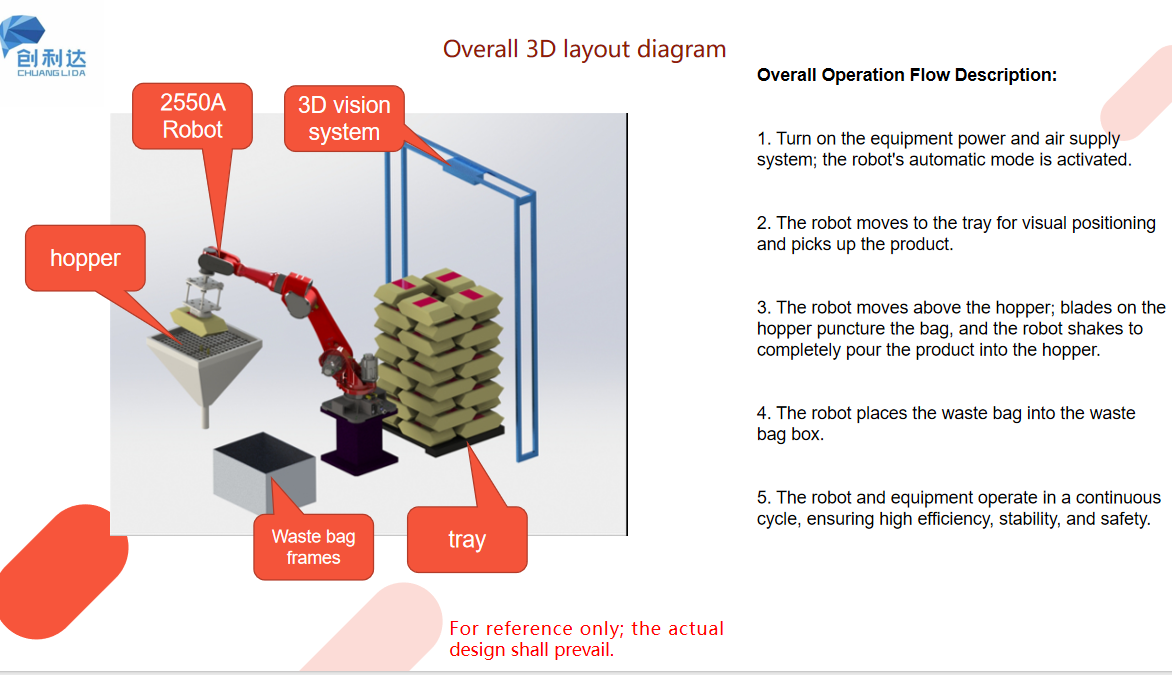
System Workflow
Pallet enters the depalletizing station
3D vision system scans the pallet and generates a 3D model
Software calculates optimal grasping points automatically
Robot picks products layer by layer, regardless of stacking pattern
Products are placed onto conveyors for downstream processing
This workflow enables continuous operation without manual intervention.
Implementation Process
On-Site Assessment: Analyze pallet conditions, product dimensions, and cycle time requirements
System Design: Customize vision algorithms, robot paths, and gripper design
Assembly & Integration: Integrate robot, vision system, and material handling equipment
Testing & Optimization: Validate recognition accuracy and depalletizing stability
Commissioning & Training: Deliver on-site commissioning and operator training
Results & Performance
Labor Reduction: Manual depalletizing eliminated, reducing labor demand by over 60%
Efficiency Improvement: Stable and continuous feeding improved overall line efficiency
Recognition Accuracy: 3D vision system maintained high detection accuracy under varying pallet conditions
Operational Stability: Reduced downtime caused by human errors
Safety Enhancement: Eliminated heavy lifting and repetitive manual tasks
Key Advantages
High Flexibility: Handles random, mixed, and irregular pallet patterns
Strong Adaptability: Suitable for future product changes without major hardware modification
Industrial Reliability: Designed for long-term continuous operation
Scalable Design: Easy integration with additional robots or production lines
Conclusion
This case demonstrates how Chuanglida's 3D vision depalletizing solution effectively solves complex material handling challenges.
By combining advanced vision technology with robotic automation, the system delivers efficiency, safety, and flexibility, enabling manufacturers to move toward smarter and more reliable production lines.