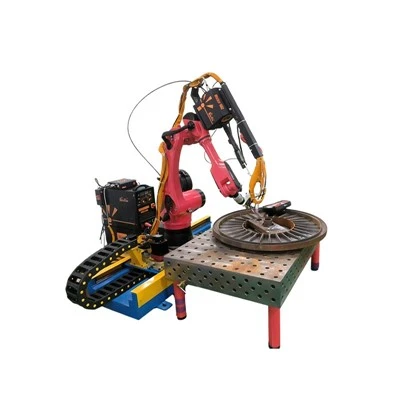
What is a Collaborative Welding Robot

Collaborative Welding Robot
Collaborative welding robot is a collaborative robotic arm equipped with a welding gun at the end and an external welding power supply. It integrates robot motion control, multi-dimensional force sensing, visual perception, and welding process control technology. It is an automated equipment that can complete welding processing synchronously with humans in a shared workspace without rigid physical isolation.
Working Principle of Collaborative Welding Robot System
The entire workstation relies on the coordinated movement trajectory of the robotic arm, welding power supply process parameters, and wire feeding system, and relies on teaching software to store welding programs, achieving continuous and stable automated welding.
The core hardware consists of 5 categories:
- robotic arm: equipped with a force control safety module, carrying welding guns, cables, and sensing components to accurately move and position along preset trajectories for mobile operations.
- Welding power supply: The core power supply unit for arc welding can stabilize voltage, adjust welding current, voltage, wire feeding speed, protective gas flow rate in real time, and match different welding processes such as MIG/TIG/plasma.
- Welding gun: a tool used at the end of a robotic arm to conduct current, transport welding wire/shielding gas, and directly form a welding arc to complete fusion.
- Wire feeder: standard equipment for melting electrode welding (MIG), capable of uniformly conveying solid/flux cored welding wire, stabilizing arc length, and reducing welding spatter.
- Teaching pendant+supporting process software: Visual drag and drop teaching interface, welders manually drag and drop the robotic arm to record the weld trajectory, built-in welding parameter library.
Collaborative Welding Robot VS Industrial Welding Robot
| Comparison Item | Collaborative Welding Robot | Traditional Industrial Welding Robot |
|---|---|---|
| Program Commissioning | Drag-and-teach programming. Welders with zero foundation can independently compile and modify programs after several hours of training, enabling quick commissioning for production changeovers. | Point-to-point programming / offline programming. Operators need to master robot code logic; proficiency takes weeks to months, resulting in a long commissioning cycle for production changeovers. |
| Operating Speed / Rated Load | Segmented speed-limited operation with a relatively small rated load. Suitable for small and medium-sized workpieces, lightweight welding torches and sensor assemblies. | Continuous high-speed operation with heavy-duty models available. Ideal for long-term mass production of heavy tooling and large workpieces. |
| Safety Protection Requirements | No safety fence required after full-area risk assessment. Built-in force limitation, collision stop and speed reduction protection; only simple local shielding is needed. | Fully enclosed safety fences, area safety scanners and multiple hard emergency stops are mandatory, requiring an isolated operating zone with high infrastructure costs for safety facilities. |
| Floor Space Occupancy | Lightweight robot body supporting floor, inverted and side mounting. It can be directly retrofitted to existing manual workstations with minimal space occupation. | Requires an independent isolated workstation with reserved safe clearance for personnel access and maintenance, leading to low site utilization. |
| Total Investment Cost | Moderate purchase price for the robot body; no high costs for safety fence infrastructure and integrated commissioning, resulting in low retrofit expenses. | Lower unit price for the robot itself, yet high overall costs including safety fencing, civil engineering, professional system integration and long-term outsourced programming services. |
| Applicable Production Mode | Flexible production featuring multiple product types, small batch sizes and frequent order switching. | Standardized assembly line mass production with few product varieties, large batch volumes and fixed workpiece specifications. |
Adaptation and Adaptation Scenarios of Collaborative Welding Robot
Scenarios for selecting collaborative welding robots:
- There are multiple product categories and small single batch production, requiring frequent switching of processed workpieces.
- There is a serious loss of welders in the industry, difficulties in recruiting and retaining workers, and a large gap in manual welding capacity.
- The order volume fluctuates greatly, and it is necessary to flexibly increase or decrease the automation production capacity, which cannot fix the assembly line.
- Processing of small and medium-sized components, with workpiece weight and size within the range of collaborative arm load and working radius.
- The machine mixing station requires welders to synchronously load, polish, and repair welding, while robots perform collaborative welding operations.
- The workshop building space is compact, with no idle areas for building enclosed robot protection workstations.
Scenarios that are not suitable for using collaborative welding robots:
- Large scale mass production of a single component (traditional industrial robots have lower production costs per piece).
- The demand for ultra high precision welding in aviation, military and other industries requires multiple layers and complex thick plate welds, with strict control over weld consistency and deformation.
- Large heavy-duty structural components with workpiece weight and size exceeding the rated load and maximum working radius of the collaborative robot.
- Pure non-standard one-time customized workpieces, no duplicate orders, high frequency of annual production changes, and no reusable welding procedures.
- High speed laser welding mass production line has strict requirements for welding line speed.
Welding process and compatible materials
| Welding Process | Carbon Steel | Stainless Steel | Aluminum Alloy | Supplementary Notes |
|---|---|---|---|---|
| MIG/GMAW (Gas Metal Arc Welding) | ★★★★★ | ★★★★★ | ★★★★☆ | The mainstream process for collaborative welding, featuring easy commissioning and high overall efficiency. Porosity tends to occur during aluminum alloy welding, so a pulsed power supply is required. |
| TIG/GTAW (Gas Tungsten Arc Welding) | ★★★★ | ★★★★★ | ★★★★☆ | It delivers nice weld appearance with little spatter, suitable for thin-walled precision parts. Its welding speed is slow, and high precision is required for the fit-up gap of workpieces. |
| Laser Welding | ★★★ (High-end Models) | ★★★ (High-end Models) | ★★★ (High-end Models) | It boasts fast welding speed and minimal thermal deformation. The complete laser workstation involves extremely high costs and is only applicable to high-end precision parts. |
| Plasma Welding | ★★★ | ★★★ | ★★ | A niche special process, only used for precision sealing welds on thin-walled parts with poor general applicability. |
For single-pass corner joints and butt welds of thin and medium-thickness plates, the collaborative welding robot is capable of stable batch machining without the deployment of extra sensing devices.
When carrying out multi-layer and multi-pass welding on plates with a thickness of 6 mm or above, the collaborative welding robot needs to be matched with a weld seam tracking sensing system and high-precision positioning fixtures. Such configurations can compensate for workpiece assembly gap deviations, thus preventing common welding defects including weld bead offset and incomplete fusion.
The most prominent technical limitation lies in the continuous multi-layer welding of ultra-thick heavy-duty plates exceeding 20 mm. Under such working conditions, the collaborative welding robot is constrained by the insufficient load capacity and structural rigidity of its collaborative arm, which tends to generate vibration and further compromise overall welding precision.
To sum up, collaborative welding robots break the space and safety barriers of traditional industrial welding equipment, combining flexible man-machine cooperation, low transformation cost and simple operation. They perfectly solve the pain points of multi-variety small-batch processing, welder shortage and limited workshop space faced by most small and medium-sized manufacturing enterprises.
While collaborative welding robots cannot fully replace heavy-duty industrial robots for large-scale mass production and ultra-thick plate precision welding, they have become the preferred lightweight automated welding solution for flexible manufacturing scenarios. Supported by mature MIG, TIG and auxiliary laser/plasma welding processes, paired with visual seam tracking and force sensing modules, our collaborative welding series delivers stable, consistent welding quality with fast production switching.
If you are troubled by unstable manual welding efficiency, frequent product changeover or insufficient factory space, our collaborative welding robot system can be customized according to your workpiece size, material and batch demand. Contact our technical team for on-site workstation layout planning, process testing and one-stop turnkey automation transformation solutions.