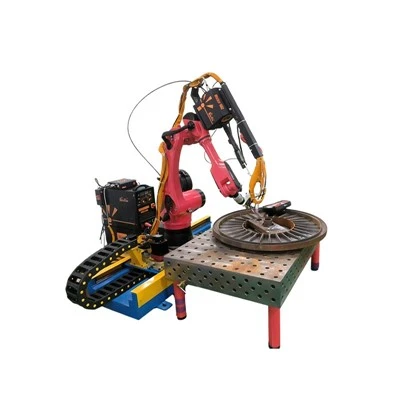
How to Select Laser Welding Robots
What Is Robotic Laser Welding and Its Working Principle?
Robotic laser welding combines a focused laser light source with programmable industrial robots or collaborative robots. It replaces manual handheld operations with stable and controllable mechanical movements to achieve a high degree of repeatability in welding processes.

A high-energy-density laser beam is precisely focused on the joint of workpieces, instantly melting the metal locally to form a tiny molten pool. Driven by the robot, the laser head moves at a constant speed. The molten metal spreads continuously and then rapidly cools and solidifies, forming a weld with dense metallurgical bonding.
Core Features: The laser delivers highly concentrated energy with extremely low heat input and a narrow Heat-Affected Zone (HAZ), resulting in minimal welding deformation of workpieces. It is suitable for welding thin plates, precision parts and dissimilar metals.
Glossary of Professional Terms
| Professional Term | Definition |
|---|---|
| Heat-Affected Zone (HAZ) | The area adjacent to the weld seam that is heated but not melted. A smaller heat-affected zone leads to less welding deformation of the workpiece. |
| Molten Pool | The local liquid metal region formed after the laser melts the welding joint. |
| Heat Input | The energy absorbed per unit length of the weld seam. A core advantage of laser welding lies in concentrated energy and low overall heat input. |
Core Advantages of Robotic Laser Welding
Ultra-high Repeat Positioning Accuracy
The repeat positioning accuracy of the 6-axis industrial robot reaches 0.02~0.05 mm. For mass production of thousands of workpieces, the weld position, penetration depth and weld formation remain completely consistent, eliminating manual operating errors and greatly reducing rework rates.
Low Deformation & Superior Surface Quality
With low heat input, thin plates show no obvious warpage after welding. The welds are narrow and smooth, allowing the grinding process to be omitted or greatly simplified, which significantly cuts the repair rate.
Greatly Improved Processing Efficiency
For welds of the same length, the welding speed of the laser robotic welding system is 3 to 8 times that of TIG welding and 2 to 5 times that of MIG welding. The efficiency gain is most remarkable for long straight welds and mass-produced standard parts. The improvement is limited for short, complex and special-shaped welds, so a tenfold efficiency increase must not be blindly expected.
Labor-saving Automated Production
Unattended night-shift operation is available once commissioning is completed. Human resources are shifted from manual welding to programming, tooling commissioning and equipment inspection, easing the difficulty in recruiting professional welders.
Enhanced Operational Safety
Operators are stationed outside the laser safety enclosure, avoiding direct injuries caused by strong light burns, high-temperature spatter, welding fumes and zinc vapor exposure.
Compatible with Welding of Special Materials
It supports lap welding of carbon steel, stainless steel, galvanized sheet, aluminum alloy, copper, titanium alloy and dissimilar metals. Stable weld formation can be achieved for highly reflective materials when paired with high-power laser generators.
Howto Choose a Laser Welding Robot
Sequential Constraints in Equipment Selection: Laser Power → Robot Body Type → Auxiliary Accessories. The selection scope of the subsequent item shall be narrowed down only after the previous parameter is confirmed.
Step 1: Determine Laser Power Based on Workpiece Material and Plate Thickness
Two types of fiber lasers are available: continuous-wave fiber lasers (ideal for deep penetration welding and thick plates) and pulsed fiber lasers (for ultra-thin precision components). The table below serves as a reference for continuous-wave fiber laser selection. The actual welding penetration is affected by defocus amount, welding speed, wire feeding mode, shielding gas type and assembly gap. Process trial verification is mandatory before formal mass production.
Selection Reference Table for Continuous-Wave Fiber Lasers
| Material | 1–1.5kW Continuous-Wave Fiber Laser | 2–3kW Continuous-Wave Fiber Laser | 6kW and Above Continuous-Wave Fiber Laser | Special Remarks |
|---|---|---|---|---|
| Carbon Steel | Autogenous welding for thin plates ≤2 mm | Filler wire welding for plates 2–5 mm | Multi-pass deep penetration welding for plates 5–10 mm | 2kW and 3kW models are mainstream options for general structural parts |
| Stainless Steel | Precision sealing components ≤2 mm | Sheet metal cabinets with thickness of 2–4 mm | Thick structural components of 4–8 mm | Argon shielding is preferred to avoid oxidation and yellow discoloration |
| Galvanized Steel | Thin plates ≤1.2 mm; zinc layer removal is required in advance | Cabinets of 2–4 mm; oscillating welding is compulsory | Thick galvanized structural components | Zinc vaporization easily causes dense porosity; direct autogenous welding is prohibited |
| Aluminum Alloy | Only applicable for ultra-thin workpieces within 0.8 mm | Filler wire welding for thin plates of 1–3 mm | Medium-thickness aluminum plates of 3–6 mm | High laser reflectivity; adopt negative defocus process and increase shielding gas flow rate |
| Copper / Brass and Other Highly Reflective Materials | Hard to form effective welds; not recommended | Thin plate welding with strict process control and filler wire | High-power laser above 6kW plus pulsed waveform is required | Surface polishing pretreatment and pure argon shielding are necessary |
Two Common Misconceptions in Laser Power Selection
Blind procurement of ultra-high-power models: It will lead to higher costs in equipment purchase, water cooling and safety protection. Thin plates are highly prone to burn-through. Only a 10%–20% power margin needs to be reserved; top-spec high-power models are unnecessary.
Neglecting power requirements for highly reflective materials: Aluminum and copper reflect most laser energy. For the same plate thickness, the required laser power is more than twice that for carbon steel. Selecting power parameters based on carbon steel will result in incomplete fusion and cold welds.
Step 2:Robot Body Selection (Comparison of Two Types of Robots, Handheld Laser Welding Excluded)
This selection only applies to 6-axis equipment for automated workstations, determined based on production output, product changeover frequency, factory space and budget:
1. Fixed 6-axis Industrial Robotic Arm Application scenarios: Mass production of a single product, high-cycle production lines, and heavy thick-plate workpieces. Advantages: High payload, wide optional reach range, fast moving speed, and excellent stability for long-term continuous operation. Disadvantages: Large floor space occupation, higher investment for the matched enclosed laser safety cabin, and longer commissioning time for product changeovers.
2. Collaborative Robot (Cobot) Application scenarios: Medium and small-batch production, frequent product changeovers for multiple product types, limited factory space and constrained budgets. Advantages: No heavy-duty safety cabin required, high flexibility, quick repositioning and tooling replacement, as well as simple operation and commissioning. Disadvantages: Relatively low payload, lower moving speed than industrial robotic arms, and limited production capacity under working conditions requiring deep penetration welding for thick plates.
Selection Summary
Choose a 6-axis industrial robot if high production capacity and single-variety mass production are required. Opt for a collaborative robot for multi-variety production, limited workshop space and low-cost entry-level automation deployment.
Step 3:Selection Checklist for Core Auxiliary Components
Laser Welding Head
Welding heads with oscillating welding function are preferred, which can compensate for assembly gaps ranging from 0.2 mm to 0.8 mm and widen weld seams. The focal length shall match the operating space of workpieces. Oscillating welding heads are mandatory for galvanized steel sheets and aluminum workpieces.
Laser Generator
The power shall conform to the parameter determined in the first step of equipment selection. Brands with local after-sales service and low failure rates are recommended. Continuous-wave fiber lasers are adopted for continuous deep penetration welding, while pulsed lasers are used for ultra-thin precision parts.
Servo Wire Feeder
A servo-driven wire feeder is required to ensure stable wire feeding without jamming. It supports common wire diameters of 0.8 mm, 1.0 mm and 1.2 mm. Wire feeding can be omitted to adopt autogenous welding only for thin-plate precision lap joints with assembly gaps less than 0.1 mm. Filler wire welding is compulsory for thick plates, large gaps and high-stress joints.
Weld Seam Vision Tracking System
2D Vision: Low cost, suitable for simple straight welds.
3D Laser Vision: Capable of gap detection, height difference measurement and automatic deviation correction, which is essential for multi-variety and high-precision workpieces. The vision system can be removed to cut costs for mass-produced single-type simple workpieces.
Industrial Chiller
The chiller must be matched to the rated power of the laser. Dual-temperature dual-control chillers are required for high-power models to cool the laser generator and welding head separately. Undersized chillers will trigger power derating of equipment and directly reduce production line cycle efficiency. Extra cooling capacity margin for chillers should be reserved for workshops with high ambient temperatures.
Key Process Points for Robotic Laser Welding
Arc Start / Arc End Control
Add gradual power ramp-up and ramp-down functions in the robot program to avoid porosity at arc initiation and crater cracks at arc termination. Extend the post-flow shielding gas duration for thin plates to prevent weld oxidation.
Oscillation Welding Parameters
The standard oscillation width ranges from 0.6 mm to 1.5 mm with an oscillation frequency of 10–30 Hz. A larger oscillation amplitude shall be adopted for wider assembly gaps.
Reference Travel Speed for Robots (Continuous-Wave Fiber Laser)
Thin-plate autogenous sealing welds: 800–2000 mm/min
Medium & thick plate filler wire structural welds: 300–800 mm/min
Highly reflective aluminum alloy workpieces: 200–500 mm/min
Multi-layer & Multi-pass Welding
For plates thicker than 6 mm, layered welding is required. Use high power for the root pass to guarantee welding penetration, and reduce power for the capping pass to optimize weld appearance. The surface oxide layer must be cleaned after each welding layer.
To see whether we fit, put a real requirement in front of an engineer. Send your part drawing, cycle time, and cell constraints, and we'll come back with a configuration and a lead time.